
Learn gypsy jazz arpeggios, chords and standards
Haute Gitanerie is a free tool for gypsy jazz guitar (jazz manouche). Play any arpeggio, in any key, all over the neck. Compact position boxes, or the long diagonal shapes manouche players actually use, sitting right next to real chord voicings and the grilles of the standards.
It's a work in progress, and I keep adding to it as I learn. A few of the diagonal fingerings aren't nailed down yet, so a small construction marker shows up on any shape I haven't confirmed as properly manouche.
Where the name comes from
Before I'd heard a single note of gypsy jazz, I already dressed the part without knowing it. Pleated linen trousers, made-to-measure shirts, proper leather shoes.
And I travelled light. One guitar bag: the instrument on one side, three days of linen on the other. Rinse a shirt at night, dry by morning, stay a little classy on the road.
Strapped to that bag, a small amp and a fishing rod, so I could stop anywhere and just be in the moment. The first time I ever played in public was exactly that, Rodrigo y Gabriela on a street in Korea. And wherever I landed, I loved to cook for whoever was around.
Then gypsy jazz found me. I spent a week at Frédéric Leau's, and one evening, telling this story, someone laughed: « Mais t'es en train de faire de la vraie haute gitanerie ! » It stuck.
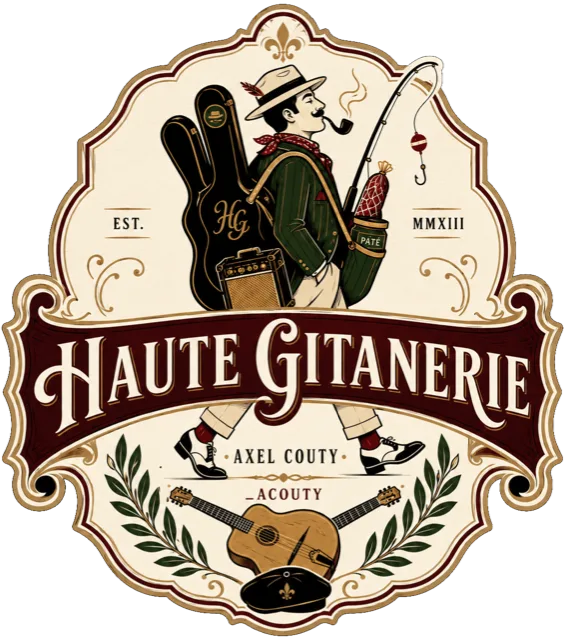
I drew the logo that same week, firing up a barbecue for the musicians. The dandy with a guitar on his back, rod in hand, off to the next moment. That's him, right here.
The app is that same spirit. Something you carry light, open anywhere, and pass around. Which is exactly why it's free. Knowledge, like a good meal by the fire, is better shared.
- Which arpeggios and chords are in here?
Every root, all twelve keys, across the qualities you actually use in manouche: minor, major, dominant 7, minor 6, half-diminished (m7♭5), diminished and 6/9. Each one as single-note arpeggios and as chord voicings.
- What's the difference between a box and a diagonal form?
A box keeps the arpeggio inside about five frets. It's compact and easy to memorise. A diagonal runs up the neck across two octaves, the way most manouche players sweep it. That diagonal is the idiomatic one.
- Why do some arpeggios show a construction marker?
Because I haven't confirmed that diagonal fingering as properly idiomatic yet. The notes are right, I'm just still refining the exact shape. Minor and major are done. The rest get added as I learn them.
- Is this the CAGED system?
The boxes rest on the same idea as CAGED: movable shapes that map a chord across the neck. But manouche players think in diagonals, not CAGED names, so I show both.
- Can I see note names in solfège?
Yes. Switch between English (C, D, E) and solfège (Do, Ré, Mi), and tap any note on the neck to see its name.
- Is it really free?
Completely. It's a gift to the gypsy jazz community.
Why it's free
Django couldn't read music. Two fingers after a fire, he hacked a whole genre into being, by ear, by feel, by ignoring the rules. To me, that's what a gitan is. A hacker.
Haute Gitanerie is made in that spirit. No signup, no ads, no paywall. The whole tool, free, for good. Knowledge should be open, the way Django cracked jazz wide open for everyone after him.
I'm a builder who plays. I make this on nights and weekends because I love it. If it helped you, you can buy me a string. That's it. No pressure, ever.
A word on AI
I'll be upfront about it. AI is one of my tools, and I use it to help with:
- app design
- coding
- the logo and the animated logo
- the software architecture (the calls are always mine)
What it never touches is the music. The arpeggios, the voicings, the grilles: all of it comes from the players and the tradition. Even the backing tracks are built with plain, hand-written algorithms, not AI.
Like a lot of people, I believe music should stay alive, and bring us closer together.